
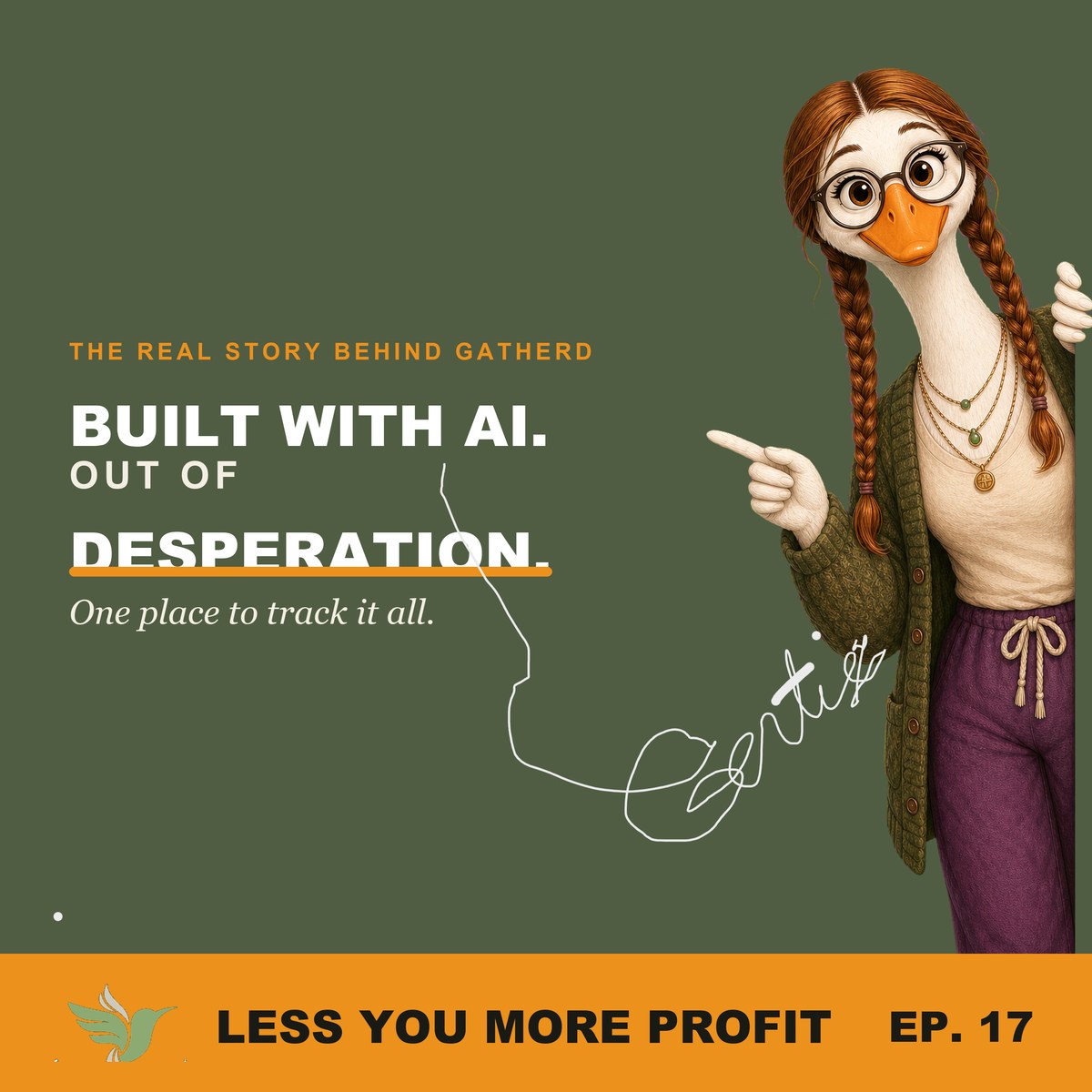
Episode 17
From Desperation to One System: Building Gatherd with AI to Track Everything in One Place
Jul 20, 2026
Show notes
The real origin story — losing consulting income in January, refusing to abandon a year of learning, and building with AI the daily operating system that became Gatherd: one place to track everything. Plus the friend who lost 20 pounds using an early version and made me realize this wasn't just for me.
Track this with Gatherd
One place for your food, spending, habits, and time — no app-switching.
Ready to systematize your business?
PRAISED is a 10-week, discernment-first program for small business owners.
Transcript
Read full transcript+
[0:00] INTRO
Welcome to Less You, More Profit — the podcast for small business owners who want to work less, stay focused on what matters, and build a business that actually supports their life.
If you're running a small business and feel like you're doing everything, all the time, and still wondering why it never feels like enough — you're not alone. I'm Shana. For a long time, I believed that if I could do something myself, I probably should. But what I've learned, and what I share here, is that just because you can do it doesn't mean it's what you're called to keep doing.
Around here, we talk about simplifying what's complicated, reducing friction in your day-to-day work, and creating systems that give you real margin — in your time, your energy, and your focus. Nothing fancy, nothing overwhelming. Just practical ways to stop carrying more than you were ever meant to carry alone. And yes, I approach all of this with faith in mind — not in a heavy way, just the belief that we're meant to be good stewards of our time, our gifts, and our energy.
[1:14] THE REAL STORY (FROM THE CAR)
Hey, welcome back. So — true to form — Mom is waiting for kiddo to be done with youth group, so I'm recording in the car. If you're new here, I'm Shana Celeste, at Less You, More Profit, where we talk about building a life that actually has room for you in it.
Today I want to do something a little different. I want to tell you about Gatherd. It's an app I built — but I want to tell you the real story behind it, not the polished version. This version starts with me losing my consulting contracts in January, and ends with my friend hitting his goal weight — and me getting super excited about yet another product I really want to share with the world.
[2:00] LOSING MY INCOME IN JANUARY
So — January. Budget cuts at both companies I was contracting for. Despite reassurance from the larger contract all through December, I was told just before Christmas that they couldn't afford to continue the consulting work that had been my main income. The second contract still had quite a few hours left on the original agreement, because I'd cut that one back so I could help keep it as long as possible. And to be honest, with that one, I automated myself out of a job — sometimes that's hard not to do as a process person.
At the same time, my husband's business was going through a little uncertainty. So: two income streams in the air at the same time, a household to run, a mortgage to pay, kids to take care of. So I started pushing for some other contracts and picked up the job hunt. And if you've been there in the last couple of years, it's basically a full-time job by itself. It feels like you're a little minnow in a huge ocean.
[3:04] THE PIVOT: LEARNING, A NEW COMPANY, AND A "GOD-THING" JOB
But here's the thing. In January, I also had a hugely inspirational conversation with my brother. I'd been deep in learning — pushing all the AI tools to build and run things for me. I learned all about C-corporations and venture capital. I started a whole new company and built a business plan for software that I thought would address a huge gap I'd observed in all the enterprise architecture work I've done — watching companies go through mergers and acquisitions, and especially the IT team. But I'm sure other teams feel the same struggle to get the information they need from the company. So I'd started building that.
By the time I finally landed a W-2 position — which, by the way, I was incredibly lucky to even see the job posting for, because I knew someone who gave me the inside referral. And I got even luckier that the hiring manager happened to be someone I'd worked with before and really respected. I still went through all the hurdles, did all the interviews, and worked hard to get the job. But I also think it was a God thing. I think it put me in the right place at the right time, and I couldn't be more grateful. I also ended up joining an amazing team — all super supportive of each other, extremely professional and hardworking, and all going the same direction, which is something that's few and far between, I think, especially in IT. So I'm super grateful for that, and it gave me the breathing room.
But by the time I got that, I was already reaching out to investors with the other company I'd built. So of course I accepted the role — and I had three weeks before I was going to start. I'd made so much progress on the other company and the concept that I really believe, if we can get this launched, it will be a game-changer at the enterprise level. So I wasn't willing to abandon it all. And I started asking myself: what if I could build a system that keeps me moving even when I only have an hour here and there in the evenings, or a little weekend time? What if I could offload enough of the daily noise that I could still make real progress — just slower?
[5:45] BUILDING THE FIRST VERSION ("BE MOM FIRST")
So I built the first version. It wasn't called Gatherd — it was called Be Mom First, because I already had that domain. And it was literally just my own operating system. I had a daily standup — I'd basically taken the daily-standup checklist I shared with you all on one of the first episodes and digitized it. Then I turned it into what I call a vertical kanban board. A kanban board typically has "to do, doing, done," right? But what I needed was to have each one of the companies I was working on, with "to do, doing, done" running vertically instead — so I could have everything on one pane of glass, and also check off all the daily-standup things I was tracking: What did I eat? What did I spend? Did I check off all my morning habits?
I built all of that using Claude. Then I configured an AI agent for every domain in my life — farm work, homework, kid work, and each of the businesses — and gave it a whole vision for the business: what I wanted to do, when I wanted to do it, and what my goals were. Then I worked with Claude to figure out how to have it there when I was having a discussion with these projects. I put them in projects — initially in chat, and then moved that to Cowork. Now I actually have both, and sometime I'll show you how they all work. But essentially they all read from the same source of truth and write to the same source of truth. So it doesn't matter if I'm on my phone or at my computer — they're all updating the same memory. And I watched a million podcasts to learn how to do this, too.
Once I had that, I worked on configuring the development so that eventually I could just describe — "I don't like that, I want you to change this" — and Claude could do it for me, push it all to the website, and be done. That took a bit of setting up, even though I'm an IT person and I've worked in IT for a while — I'm familiar with the concepts, infrastructure, cloud, all of it, and of course the application development lifecycle; I'd done it myself, top to bottom. So this was an interesting learning experience. I definitely learned a ton. So now I have it — I got all that infrastructure set up, and now I literally just tell it, "I want to change this, I don't like how it looks," and it pushes it all for me, and it's public. It might have been a little scrappy, but it was mine, and it worked.
[8:38] TEN MINUTES A DAY, NOT FIVE APPS
I'm now at the point where I can spend 10 minutes in the morning doing my check-in, 10 minutes at night closing the loop, and the rest of the day I can actually do things — instead of trying to remember where I wrote down the notes. I'm not using five apps anymore. I'm not switching between MyFitnessPal and a budget spreadsheet and a habit tracker — I'd actually gotten them all into one place.
[9:05] THE FRIEND WHO LOST 20 POUNDS
So, fast-forward about a month. I'd played with it and gotten it to this point, and I showed it to a friend who's interested in AI. I thought he'd appreciate the tech side of it, but he didn't get that excited about the tech — what he really got excited about was the concept of tracking by just brain-dumping what you say. He mentioned how hard he was struggling just to track his macros — he was writing them down on paper, because all the apps took too long; it was too much friction to use any of the existing ones. And he thought this would be helpful.
I thought, well, I could probably build an MVP with just the basics — I can do calorie tracking and spending pretty easily. All the other agent stuff, and actually managing tasks, and using it as a planner — that wasn't refined enough to push to any kind of public space. But those two pieces — just tracking — I felt like I could build pretty easily for him. So I built it for him, just to see what he thought. I built it all the next weekend.
And in the first few weeks, he called me and said he'd lost 20 pounds — the last 20 he'd been fighting with. That's the hard one, the one where you really have to be on it. He felt like he was meticulously tracking everything before, but he said ultimately he was still guessing — and with this, he wasn't. And of course, it's AI, so it's still estimating. One of the mottos of Gatherd in general is "logged is better than perfect." And I really do believe that. Just getting it in there — even if it's a little high or a little low, it's going to be pretty close. But the fact that you actually logged it, and stuck with the habit of keeping track, means you're not just dumping the effort at the end of the day. And apparently it worked.
[11:16] THE VISION: ONE PANE OF GLASS
So now I got super excited, and I'm all in on trying to publish this. It is published and getting out to the market, and I feel like I've gotten it to the point where I really do have a minimum viable product now. It's very inexpensive — you can do a 7-day free trial, and it's $5.99 a month. When you pay for it, eventually — if it takes off, which I hope it does — there will be a premium tier, because there's so much more I want to do with this. And I'm going to do it regardless, because I need it for me.
I don't want to go to a million different places. I want to talk to my AI. I want to do my planning — and I want to do my planning on one pane of glass. I want it to sync with my calendar. I want it to sync with my bank. I want one pane of glass that shows me everything — all my businesses, and the cross-section of what I need to do — so I can stop worrying about organizing information, sharing information, finding information. It's knowledge management, right? We're all doing this knowledge-management loop constantly. And I want to automate so much of that, so I can just take what they call tacit knowledge — something I could tell you but haven't documented — and make it explicit. But then, once it's made explicit, I don't want to have to do the work of putting it where it goes so I can find it later. I want something else to do that for me. That's what I'm trying to build for me — and I think so many other people could benefit from it. So I'm going to keep working hard at it, and I hope you'll try it and love it.
[13:09] WHAT GATHERD IS & HOW LOGGING WORKS
So I renamed it Gatherd, because that's what it does — it gathers everything. Food, spending, habits, time, planning — everything in one place. One daily check-in. (Well — you could do one daily check-in, but you really need two or three throughout the day, because otherwise you'd never get everything; you can't remember.) But the point is you're not app-switching.
When you log — literally logging a meal — it takes seconds, because you can either snap a picture of the meal before you start eating, or just tell it, "I had a grilled cheese sandwich with tomato soup." And it will estimate the calories and pick an average. You can, of course, give it more detail to get more accuracy, and you can save a favorite. So the protein yogurt from my local grocery store — you snap a picture, and it knows exactly what the calories are for that. So whenever I say "I had yogurt," it assumes it's the protein yogurt, and if it's not, I can fix that. It gets a little smarter as you go.
I've tried them all — MyFitnessPal, all kinds of things, I even have an electronic Bluetooth scale — and I never stick with any of it, because it's just too much friction. It takes too much time, and, like I said, halfway through the day I realize I can't remember everything I had, or it's too late, I didn't weigh it. You start to feel that perfection is the enemy of done. And at least for me, that's been a big hurdle in keeping track of things. And don't even get me started on spending — if I could see how much I've spent as I go through errands throughout the day, I'd probably not buy that last thing or go into that last store. But I don't see it, so I get home and think, "Oh, how much did I spend today? Oh my gosh." When I add it up, I realize — this much here, and I just had a $1,000 errand trip, and I don't think I actually had $1,000 of spending money available. So now I've got to figure that out.
[15:30] WHO IT'S FOR: THE MENTAL LOAD
So anyway — I feel like a lot of apps talk about this, but this one actually works, at least for me. The problem isn't that you don't know how to track things. It just costs too much energy. Gatherd is built for those of us who are already doing a ton — you're running a household, possibly a business or a side project, showing up for your kids, and somewhere in there also trying to take care of yourself and build something that's yours. So we don't need another app — we need fewer apps.
[15:56] THE FOUR PHASES: OBSERVE, SURRENDER, THRIVE, OPTIMIZE
The way I think about it — and this is how I designed it — is there are four phases you go through.
The first is Observe. You're getting honest. You're not trying to be perfect — you're just getting a real picture of what's happening. What are you eating? What are you spending? What habits are you actually sticking to, versus the ones you tell yourself you're doing? Most apps skip this phase — they just say, "Here you go, start tracking." But I think this one is really important, and what's different with Gatherd is that we encourage users to start with observing — and maybe you can't even see the calories yet, so you don't decide to fudge it. ("Well, I'm not going to log that, because now I know I'm already over — but I really want that ice cream.") Then you don't get an accurate picture of what you're really doing. So mask even what you're seeing in those first observation weeks, and maybe just start with one habit. Don't try to track eating first, or whatever — pick the one thing that's getting away from you most. If it's your time, your calories, your exercise, your spending — pick one, and start with that.
The second phase is Surrender. Now you're actually looking to see what isn't aligning — where what you want isn't lining up with what you're doing. You sit back and think about some meaningful goals, and you get honest with yourself: where do I need to eliminate temptation and not leave myself easy excuses?
The next phase is Thrive. Once you've got that baseline and you've set a couple of goals, now you're ready to move — you can start making small, consistent adjustments. This is not a 90-day challenge or a 14-day challenge. The goal is to build the kind of habits that are still there in two years and that last.
And this is what I'm building toward for all users — what I'd call Optimize. That's where the integrations come in. Your planning, your tracking, your health, your finances all start talking to each other, and Gatherd does most of that heavy lifting — so you don't have to. That mental load: every time you use this, the mental load comes off. That task-switching, that manual integration, that manual knowledge-management filing gets put onto the app, and then we connect it. Like I said, it'll be connected to your bank, connected to your calendar, connected to whatever you use for a planning tool outside. And what it does is bring in that cross-section of what's yours, and ultimately help you manage the risk — what are your resources? Your energy, your time, your money. So I'm not there yet, obviously, but that's what I'm building toward. I really want to have it for myself — but I also want to have it for you.
[18:45] TRY IT — FREE TRIAL & FEEDBACK
So if any of this is landing with you — please, I'd love for you to try it. Go to gatherd.me. There's a free trial, no credit card required — a seven-day free trial. And like I said, it's $5.99 a month after that. It's really inexpensive, because I want everyone to be able to use it.
If you have feedback, I genuinely want it. This is super early. I'm a founder who uses this app every single day, and I'm building it for people like me. So the best thing you can do is tell me what's working and what isn't. You can do it right in the app — just tap the light bulb on the main screen and let me know. You can vote for the next features, and you can suggest new ones.
One thing I'll note: it's not a native Android or iPhone app yet — largely because I wanted to make sure I had the basic MVP features nailed down before we tried to build that and maintain three different code bases. It is a web app, but there's a way on both iPhone and Android to make it look like a normal app — the same little icon you'd have. You just have to know a couple of clicks, and I'll put up a video of how to do that. There are also instructions right there on the FAQ on the front of the website.
[20:21] OUTRO
Thanks for listening. I'll link everything in the show notes — and if you try it, come back and tell me. I really want to know. Before you go, stay in the loop: I've got Gatherd, my life-tracking app, and PRAISED. Follow us wherever you are — social links are in the show notes. Now go simplify something, and see you next time.